Showing posts with label WotC. Show all posts

Wednesday, February 13, 2013

Freelancer Aspirations: Thrumbolg Extras Part I

So, Dragon issue 420 got published today, and with it the article I wrote with Tim Eagon titled "Thrumbolg, First Lord of Mag Tureah." I'll post something next week or so about the real source material for the story we told, but in the meantime wanted to give people the following visual guide.

The article includes a table of random destinations for the myriad magical portals in the underground citadel of Mag Tureah. Almost all of these are based off of real-world buildings or geography, and I thought I should do people the courtesy of showing them what we were looking at as we came up with the destinations.

A guide to the visual inspirations for the random portals in Mag Tureah:


1. A ruined castle of glass atop an earthmote, spiral staircase connecting it to the ground.

My inspiration here is the "Castle in the Air" from The Phantom Tollbooth. If you haven't read the book, it's fabulous. Go read it and then come back to read the rest of the post. I'll wait. Shouldn't take you more than an afternoon.

The mouth of a flooded cavern, the beginning
of an undersea road paved with huge stones.
2.  I've known for a long time about the Bimini Road rock formation, but until I saw the picture above, I'd forgotten about how large many of the rocks are.

3. A partially toppled circle of stone menhirs overgrown by jungle vines -- I was thinking primarily of what Stonehenge might look like in a jungle environment.

A gargantuan statue buried in desert sand up
to its monstrous head.

  4. For most of its existence, the body of the Sphinx has been buried until only the head & shoulders are visible. Start here, and swap on your monster's head of choice. (Or, take monstrous to refer to size.)

5. An abandoned dragon’s aerie perched on the lip of an active volcano. Nothing more need be said here, I think.

6. A temple to a long-dead god whose collapsed  ceiling opens to the night sky. (I'm sticking with our original phrasing here because I think it's more poetic).  I haven't been able to re-locate the picture that was the inspiration here, but any number of ruined cathedrals and monasteries could serve as a jumping-off point.

7. A forgotten chamber that opens up to the sewers of the largest city on the continent.  Like the dragon's aerie in number 5, I don't think a lot more need be said. Kudos to Spiderweb Software's "Avernum 2" as a starting point.

A tower overlooking a courtyard filled with petrified soldiers standing in neat rank.

8.  My inspiration here was the famous terracotta army, at the tomb of the first Qin emperor in China. I learned around the time we were writing this section that the army was originally painted!

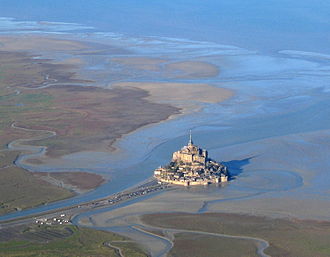
A deserted priory sprawling across a rocky tidal island
 9. The image above is of Mont St. Michel in France. Until the causeway was built in the 19th century, the monastery was completely cut off from the mainland at high tide.

A crumbling observatory open to the skies above
 10. You might have seen the Caracol thanks to the major "Mayan apocalypse" phenomenon last year. I knew about it long before that, and still love this image.

A covered bridge, woven from the roots of
living trees, over a murky river.
 11. This is a real thing. The bridges take years to create, and can be found in the Khasi Hills of India.

A frozen city built on a terraced mountaintop,
with no trace of its former inhabitants.
 12. The photograph above is of Machu Picchu in Peru; we simply encased it in ice.

Monday, January 28, 2013

Freelancer Aspirations: the Dark Pact Hexblade

I've detailed a few pieces I've written for D&D's 4th edition rule set in previous posts, and had originally intended to keep going until I'd worked my way through all of my repertoire. However, a fall semester in which I ended up with a lecture to teach for the first time while at Heartland Community College roughly tripled my grading load, and made it a lot harder to keep up with the project. At least for the moment, I'm back on it.

I'll start by noting here that, if you haven't seen it, it's been teased that the one article for which I've received a paycheck will be in February 2013's DDI issues. Although we pitched the article for Dungeon, the tease showed in Dragon, so I won't swear which one is getting it.

I picked up Heroes of the Forgotten Kingdoms because the warlock has been one of my favorite character classes for 4E D&D, in part because of how wide-open the options are for using the same basic mechanics to drive many, many different stories (through the different pacts and letting a warlock's patron drive parts of your game's story). I ended up waking up really, really early the next morning with parts of the initial pitch just stewing in my brain, and had an original pitch for this sent off to Wizards of the Coast before noon on a Sunday.

It was about a month later that I got a response back, which was along the lines of  "We've just given the hexblade a lot of word count, so we're not doing any new hexblade material for a while." I did write back asking whether it would be received better in a few months, but never got an answer. So, I turned around & pitched it to Kobold Quarterly. (The magazine is no longer in production, although they're still doing daily updates to their website and creating & publishing other print products.) I got a response along the lines of "We'll take this for the web site, but not for the magazine. Are you OK with sending it this way?"  So, I finished writing the whole thing and sending it in.

For length reasons, they split the article into 3 parts. I'll link to the last part, since it contains its own links backward through the series, although I've got a re-formatted compilation of the whole thing here.

I was trying very hard to capture the feel of spiders and lizards in the flavor text of the powers. Working from the "standard" Dark Pact Warlock, poison damage became one hallmark of the build. The decision to use acid as the other came from the caves like Villa de Luz and Lechuguilla, where the water in places is really fairly concentrated sulfuric acid. I know that, from the standpoint of folks into character optimization, this probably isn't up to snuff, but I think that I made the mechanics reflect the story I was trying to have them tell. I'd call this solid, but not innovative, work.

Monday, September 17, 2012

freelancer aspirations: superior implements

This particular entry has a long and winding history, and represents my first attempt at trying to get a gaming-related article published. Back in the fall of 2010, I contacted James Auwaerter about possibly collaborating on a pitch and article to Wizards of the Coast for D&D Insider. That spring, the Player's Handbook 3 had included the first rules for superior implements, and although it was suggested that the keywords used could be used to homebrew varieties not present, there weren't many examples shown. I had several mechanical examples that I thought were good possibilities, but wasn't as comfortable with the story side of what made for a good D&D article.

Jim was reasonably receptive to the idea of working together, and contributed several ideas. The Common/Uncommon/Rare system was just being applied to magic items at the time I originally contacted him, and he suggested that we might also want to come up with several Common magic item enchantments that could be applied to the implements we developed. He also did a lot of work on the story development in the article (below). In fact, it's probably fair to say that Jim did all of the flavor text in the article along with helping polish the mechanics.

Along with a lot of notes about proposed mechanics, the original pitch I sent Jim for some review read as follows:


This crunch-heavy article would expand on the superior implements currently available by both defining two new superior implement keywords and presenting roughly a dozen new superior implements of all types that both take advantage of the new keywords defined and present new combinations of implements and keywords. Our best estimate of the word count is approximately 1500 words.


Jim rewrote the pitch, based on the following general principles:
  1. Don't come in too high. It's easier to come in low and have them ask for more, or (in an article like this) write more than you originally pitched and ask them to pick the best of the selection.
  2. At the time, the magic item rarity rules had just been introduced, and there was a massive gap in what items were considered to be Common. Adding the magic items was a way to help make the article appeal to more possible players.
  3. At the time, the Grifnar's Arms article was only a couple months old, and was one of the best-received short articles in a long time. So, it was an attempt to link the article we were proposing to something else that was recently well-liked. In addition, the word count was boosted to match the length of Grifnar's Arms article, which had lacked any new rules content.
Bazaar of the Bizarre: Tools of the Spellcaster’s Trade
This article would present new superior implements for the discerning spellcaster. It would be in a style similar to the Bazaar of the Bizarre article "Grifnar's Arms" from Dragon 391, introducing Grifnar's elven counterpart, Aldanian. Aldanian would offer several kinds of superior implements as well as some more common magic items.
We intend to define two new superior implement keywords (enduring, to help spellcasters that summon creatures, and expansive, to help spellcasters who favor area effect spells) and present roughly a half-dozen new superior implements for all implement-using classes. We would also provide two or three common magic item enchantments that could be used with multiple types of implements. We estimate this article will be approximately 2000 words. This article is being jointly submitted by Jim Auwaerter and Jeff Dougan.
At the time, Wizards of the Coast didn't guarantee a response to every pitch submitted, and we went our requisite 60 days without hearing anything. We did both think the general idea still had legs, and ended up sending a query (pitch) to Wolfgang Bauer of Kobold Press for possible use in Kobold Quarterly magazine. He liked the general idea enough to let us write up a full manuscript (PDF version here), and sent us some notes about the Midgard campaign setting (used by KQ for a number of their articles). Wolfgang also ended up passing on buying the full article, which we figured out from seeing the tables of contents for the two issues of KQ we might have been considered for & learning that manuscripts didn't remain in the submissions pile from one issue to the next.

Some time in here, the second period in which Wizards of the Coast guaranteed responses to everybody opened up. I got a hold of Jim again and asked him if he felt like it was worth giving it one more go, since this time we'd get some guaranteed feedback. I sent it in along with a few other pitches (it ended up in my second batch of pitches in that window), and waited. For reasons unknown to me, feedback on this particular pitch was missed in the initial pass. However, I ended up following up on its status at the same time as the project that they eventually did pick up, and learned the following reasons for its rejection:
  • At the time we sent this, they had a number of Bazaar of the Bizarre articles (the series under which this would have appeared) in various stages of work, so they didn't want to add more to that series.
  • The mechanics we'd proposed were functional, but the design team didn't want to add more keywords or other new mechanics unless they addressed something vitally needed. There were also some concerns about our new introductions adding an element of "power creep" into the game.
Although I understand the concerns about the number of Bazaar of the Bizarre articles & the potential for power creep, this is one article that I have to admit I'm still disappointed didn't get commissioned for further review.

Thursday, September 13, 2012

Freelancer aspirations: the Cryomancer

Preface: Those who don't have any interest in gaming generally, and role-playing games in particular, will probably want to ignore this post since it talks about my recent experiences in a freelance project submitted to Wizards of the Coast for the Dungeons & Dragons game. I'll do my best to keep jargon out of the article as much as possible if you decide to keep reading, but you've been warned.

This project has only just reached a point where I can openly discuss it, thanks to some bad news received about it yesterday afternoon. Some background:

Wizards of the Coast currently runs two open submission periods every year for those who aspire to write freelance projects for Dungeons & Dragons Insider, the online version of what used to be Dragon and Dungeon magazines. Over the last year (two cycles), I've submitted roughly 20 pitches (two with co-authors attached) and had three projects commissioned to the state of a first draft. I got more-or-less final verdicts on two of those three projects yesterday, one of which will result in a paycheck and one of which was a rejection without request for further revision. I'm not at liberty to discuss the former project until it comes out, but I figure I'll put some lessons here on the other project.

For those who aren't gamers or otherwise into fantasy genre fiction, a cryomancer is a kind of magician whose abilities are all focused on cold. Here's the original pitch:


Class Acts: Wizard: The Cryomancer

Fire mages are flamboyant and hard to avoid noticing; wizards who specialize in cold magic are rarer. Calculating, implacable, and unforgiving, those who command the glacial ices are rare and worthy of attention. Their comparative rarity is attested by the lack of a singular figure associated with cold magic, although many famous archmages have included magical cold within their eponymous spells (including both Bigby’s Freezing Grasp and Otiluke’s Freezing Sphere).

 The pitch I sent included a little bit more, like some details on estimated word count and particular mechanical elements. In the initial response, I was given two directives to consider: first, that elemental specialists needed to have some way to deal with creatures that were resistant or immune to their element of choice. For example here, a cryomancer needs a way to cope with meeting a frost giant or a white dragon. the other directive I got was to focus more on the story side of the article than the mechanics. This PDF represents the draft I submitted, minus some internal notes to the produced & development teams on certain elements of story, credits, and the art order.

One challenge for me was that the lore of D&D doesn't really have any famous wizards who are known primarily for their use of cold magic. There are a number of D&D wizards who have used cold in some of their famous spells (Bigby's Icy Grasp made it into the 4th Edition Player's Handbook; Otiluke's Freezing Sphere was present in all of the first 3 editions of the game), but I didn't have a single wizard around whom I could build the story. I ended up dividing it up among three wizards, two of whom have lore that goes way back in the game and one of whom was my first 4th Edition character.

The discussion of "naturalist" vs. "elementalist" varieties of cryomancy came about rather late in the writing process as I wrestled with balancing not creating large quantities of new story elements out of  whole cloth
with the directive to focus more on the story elements of the article. I was also trying very hard not to make the whole thing "pyromancers are like X, cryomancers are like Y," although a little bit of that still slips through.

I heard back yesterday with the article's rejection, and I'm actually not surprised. The mechanics were OK, but not inspiring, and I did got a bit too far with the story elements. It's been said by Wizards of the Coast staff in previous public places that, if a draft has promise but just isn't quite there, they'll work with you to make the work the best it can be. (From the project that will result in a paycheck, I can say that's true. I can't elaborate more right now, but will probably try to write something like this about that project when it becomes public.) Overall, this article just didn't have anything they could point to as being fixable.

I'm still very new at the RPG-freelancer thing, but I agree that the article definitely didn't deserve to get bought as-is. I think I was hoping that there would be a little more guidance on ways to help the story become more cohesive, perhaps because I think the idea of a winter wizard still has lots of potential. I just wasn't the person to get it there -- at least, not with my current degree of skill. Maybe I'll come back and revisit this idea someday, after I've got some more design experience. If I do, I'll be sure to let people know.